


Three boring measures that matter more than any claim
In our industry, customer satisfaction has nothing to do with the buying experience. Nobody buys a carbide die and feels excited about it. The best possible outcome is that nobody notices: the tool arrives, gets mounted, runs, and for months nobody has to talk about it.
Put another way: in this business, satisfaction is the absence of problems. That makes it hard to describe and easy to overstate, because any supplier can claim to have happy customers.
So it is worth defining what we are actually measuring.
First measure: it arrived when it was needed
It is the most basic measure and the most underrated. A tool delivered late to a stopped line is not just a late tool: it is lost production, and the value of that production far exceeds the value of the part.
That is why the delivery date is not a logistics detail but a supply specification, exactly like a tolerance. A supplier who promises short lead times and routinely misses them can cause more trouble than one who quotes longer lead times and meets them: at least the second one lets you plan.
The question to ask is not “how fast do you deliver,” but “out of a hundred orders last year, how many arrived by the confirmed date?”
Second measure: it fit without adjustments
A tool that needs rework, a shim, or a small correction before it goes on the machine has already failed, even if it runs well afterward. It has eaten up toolroom time, delayed the start, and above all introduced a variable: the part on the machine is no longer exactly the one on the drawing.
First-time fit is one of the most direct indicators of supply quality, because it measures whether the part can go into production without additional work.
The question to ask is: “out of a hundred parts delivered, how many went on the machine without any rework?”
Third measure: it lasted as long as expected
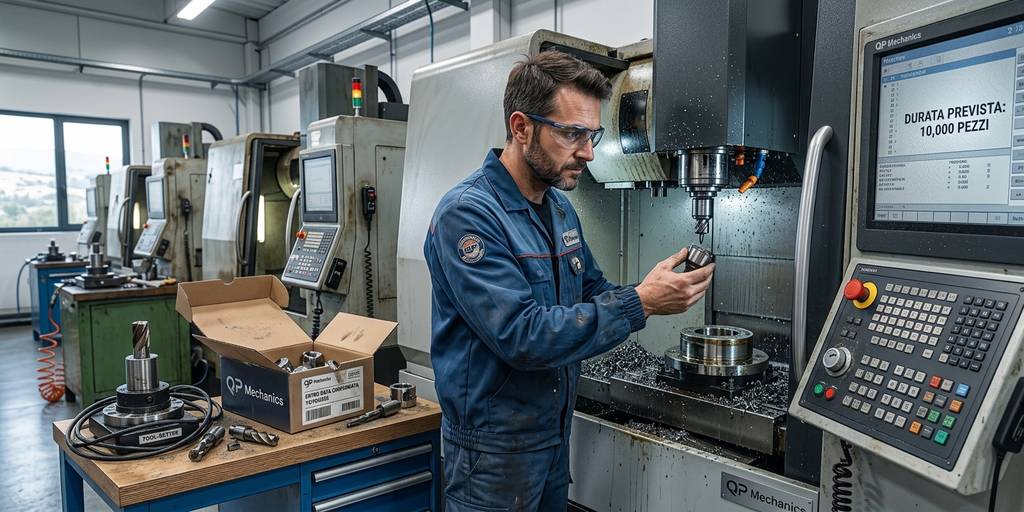
This is where evaluation gets trickier, because tool life also depends on the material being machined, the setup, and maintenance. But that is exactly why what matters is the deviation from what was expected, not the absolute number.
A tool that consistently underperforms signals that something, whether material selection, construction, or application conditions, needs to be reviewed. A tool whose performance varies widely from one piece to the next may point to poor repeatability in the manufacturing process, especially when operating conditions are comparable.
The question to ask is: “for this application, how long does the tool last on average, and how much does that vary from one piece to the next?”
Why to be wary of a single percentage
A “95% customer satisfaction” figure always looks good in a brochure. The trouble starts when you ask how it was calculated. If it comes from a survey sent to customers who have already reordered, it mostly measures whether the relationship survived. If it comes from the ratio of orders without complaints to total orders, it measures something more concrete.
The difference is not academic: in the first case, lost customers do not answer the survey, so they are never counted. The toughest figure, and the most useful one, is the one that includes the customers who left.
If a supplier quotes you a percentage, the question to ask is simple: what is it based on, and over what period? A precise answer is worth more than the percentage itself.
The standard we propose
Don’t ask us to call ourselves reliable. Ask us what we can actually measure.
Over the past 12 months (September 2025 – August 2026, based on 1,240 orders):
- 77% of orders were delivered by the confirmed date;
- 96% of orders were closed with no complaints or rework.
On its own, the first figure does not tell us whether we are better or worse than average: we do not have a reliable industry benchmark. What we can say is that on-time delivery is one of the strengths our customers mention most often, including when comparing us with other suppliers.
That is not a statistic. It is feedback. And we prefer not to confuse the two.
Tool life, on the other hand, is harder to turn into a single KPI: it depends on the product, the application, and the operating conditions. It is a figure that makes more sense to review together with the customer, case by case.
So satisfaction does not lie in a single percentage.
It lies in verifiable numbers, read for what they actually mean.
If you are already a customer, ask us for your numbers: we will show them to you order by order.
QP Mechanics builds custom precision tooling to drawing, in tungsten carbide and tool steels.