


Why the right question isn’t “who makes it”, but “what is worth keeping in-house”
Almost no in-house toolroom is born from a strategic decision. It is born from an emergency: a spare part needed right away, a die to touch up during the shift, a skilled person and a free grinder in the same building.
Then it grows with production. One machine is added, then another. And at some point it becomes part of the landscape: it’s there, it works, nobody asks any more whether it still makes sense as it is.
The question usually comes back at three moments, and they are rarely calm ones: when the person who knew how to do everything retires, when a new machine has to be bought, or when a peak in workload leaves production standing still, waiting for a part.
We are writing as an outside supplier, so we might as well say it straight away: an in-house toolroom has real advantages, and giving it up doesn’t always make sense.
The point is not choosing between inside and outside. It is understanding what to keep inside, and why.
Knowing how and knowing why are not the same thing
This is the distinction that usually gets skipped.
The value of an in-house toolroom often doesn’t lie in making the tool. It lies in knowing the process: why that die gives out after a certain number of parts, how that press behaves when the wire batch changes, what is worth changing on the next order.
That knowledge belongs to the company. It should be held on to, documented, protected.
Manufacturing is a different matter. It can be assessed more freely, and without sentimentality.
There is also a less obvious advantage in working with an outside supplier: a specialist supplier sees similar problems tackled in different companies and industries. Sometimes that experience leads to solutions that would never have been considered inside a single plant.
Process knowledge should stay in-house. Manufacturing is open to discussion.
An idle machine costs money even when it isn’t working
These are major investments, and on top of them come maintenance costs that are significantly higher than for machining conventional materials, because the hardness and abrasiveness of tungsten carbide put machines and components under heavy strain.
Investments and costs that pay off on one condition only: that the machines are working.
A grinder used three days a month has a real hourly cost very different from the one in the accounts. A grinder that is busy all year round, on the other hand, is probably exactly where it should be.
The question isn’t how much the machine costs. It’s how many hours a year it actually produces.
And there is a corollary that is often forgotten: a machine that runs little also tends to be operated by people who operate it little. Which, on carbide, is rarely good news.
The same goes for measuring equipment. Machining carbide to a few microns only makes sense if those microns can also be verified. A precision grinder without inspection equipment and procedures to match risks producing parts whose precision is only assumed. That, too, has to go into the calculation.
People before machines
In this trade, repeatability depends heavily on who does the work. We wrote about it when discussing the twelfth part that must be identical to the first: the choice of grinding wheel, the way a part is clamped, the moment to stop when lapping are decisions that no program fully contains.
An in-house toolroom that relies on one or two experienced people is very strong. As long as those people are there.
It is worth asking today, and not on the day of the retirement party, who will take their place. And how long it will take before they are really able to do the job.
Close doesn’t always mean fast
On speed, the in-house toolroom starts with an advantage, and it would be dishonest to deny it. A tool that needs touching up during the shift can be fixed in-house in a few hours. No outside supplier is that close.
But the advantage only holds while there is spare capacity. At peak times, when the toolroom is busy with emergencies, new jobs pile up.
And lead times get longer exactly when they should be shorter.
The cost that doesn’t show up anywhere
The cost of a tool made in-house is rarely seen in full. There are the hours, of course. But also machine depreciation, grinding wheels and consumables, measurement and inspection, training, scrap, and the time of whoever follows the job instead of doing something else.
Often the comparison is between an outside quotation, which includes everything, and an internal cost that includes only the hours.
There is another difference too: an in-house toolroom keeps most of its costs even when work drops off. Outsourcing some operations, on the other hand, turns part of those costs into variable costs that follow actual volumes.
It isn’t necessarily cheaper. But it can make the company more flexible, especially when workloads are uneven.
The numbers won’t necessarily go against the in-house option. But they have to be worked out before comparing them with a quotation.
The signs it’s time to rethink
There is no need to wait for a crisis to ask the question. Some signs usually show up first:
- Emergencies have taken the place of planned work. The toolroom spends its days chasing spare parts, and new projects slip from week to week.
- An important machine needs replacing. This is when the choice costs the most, and so the moment to make it with the figures in hand.
- The know-how sits in one person’s head. If certain jobs simply don’t get done when one person is on holiday, the risk is already there.
- The same operations are rarely repeated. Occasional jobs on difficult materials are where experience matters most and builds up least.
None of these signs, on its own, tells you what to do. Together, they tell you it’s worth looking at the numbers.
Working with an outside supplier without losing control
One of the most common fears when part of the work goes outside is losing know-how. It is a legitimate fear, and it can be managed.
The drawing stays yours. The information on how the tool performs, how long it lasts and how it ends its life stays yours. In fact, it becomes more important, because it is what allows whoever builds the tool outside to build it well.
The relationship works when the in-house toolroom becomes the technical reference point for the supplier: the people who know what is needed, check what arrives, and report back on what happened on the machine. Not a department being emptied, but a department changing its role.
What to ask an outside supplier
If part of the work goes outside, it is worth choosing the supplier with the same questions you would ask about an in-house department:
- Who will machine my part, and how long have they been doing it? On carbide, people’s experience matters as much as the machines.
- What do you keep from my order? Drawings, measurements taken, agreed changes. A repeat order shouldn’t start from scratch.
- What happens during my peak periods? A supplier working for many customers has peaks of its own. Better to know beforehand.
- Do you want to know how the tool performs on the machine? A supplier that isn’t interested in feedback is a supplier that won’t improve.
They are simple questions. The answers, usually, are less so.
How it usually ends up
In practice, many companies arrive at a split along these lines:
- In-house: maintenance, touch-ups, regrinding, simple steel components, trials and prototypes.
- Outside: specialist operations requiring investments that are hard to keep fully utilised, components with particularly demanding tolerances, repeat series and workload peaks.
It isn’t a rule. It’s a starting point.
Five questions before you decide
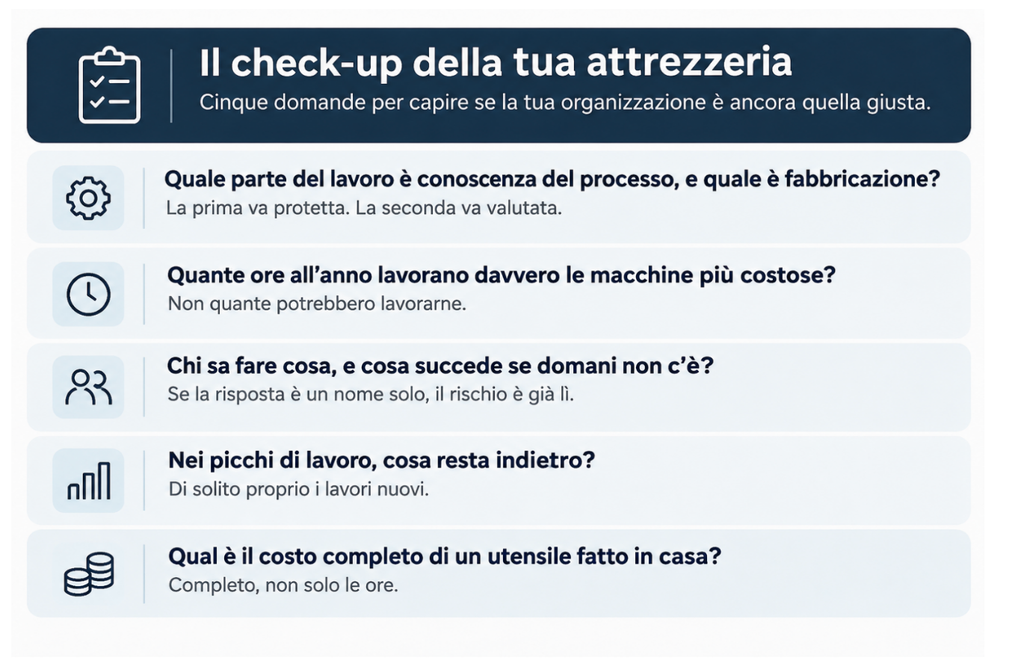
With these answers, the decision stops being a matter of habit and becomes a matter of numbers.
The numbers may even say to leave everything as it is.
But at that point it will be a choice, not an inheritance.
QP Mechanics builds dies, punches and precision components in tungsten carbide and tool steels, to customer drawings, and provides subcontract grinding, EDM and lapping.