


How to read a tool at the end of its life so you can specify better on the next order
On an impact extrusion line there are two modes of tool failure that are particularly worth telling apart: progressive wear and brittle fracture.
Both sometimes end up in the same convenient category — “it broke”. The trouble is that they describe two very different problems and can lead to exactly opposite material choices.
Telling them apart usually does not require a metallurgical laboratory. It requires, first of all, looking at the part and knowing what you are looking at.
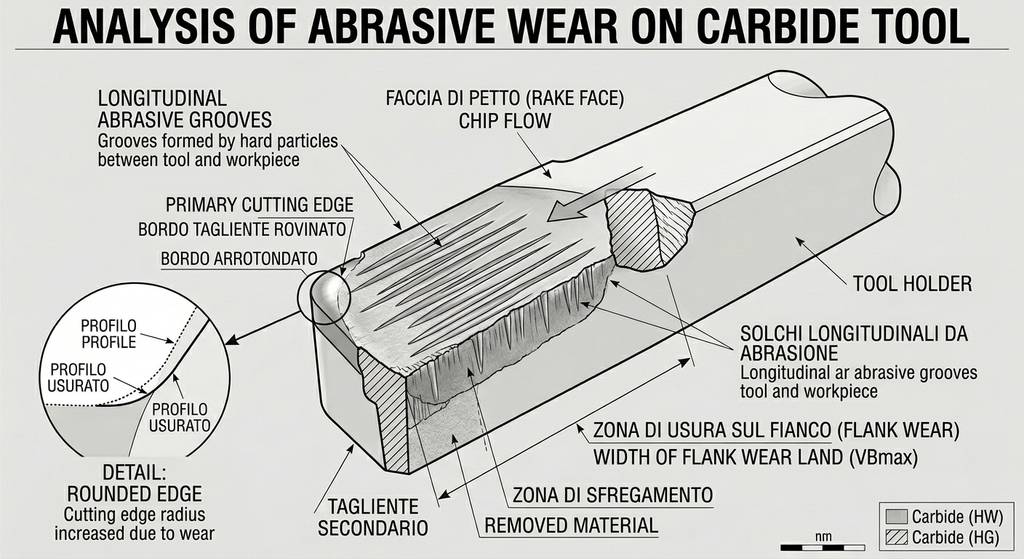
The first mode: abrasive wear
The tool keeps its general shape but loses size. The surface dulls, scoring appears in the direction the metal flows, edges round off progressively. The parts produced drift slowly out of tolerance.
It is a gradual and predictable decline. Anyone keeping a record of cycles can schedule the replacement before the defect reaches the product.
When abrasive wear is the prevailing mechanism, the direction is generally towards greater hardness and wear resistance. In cobalt-bonded tungsten carbide this normally means moving towards finer grain sizes and/or lower binder contents.
The second mode: brittle fracture
The tool is still dimensionally sound, but it has lost a piece. Chipping on an edge, a crack starting from a corner, in the worst cases a clean fracture. There is no warning: up to the stroke before, it was producing perfectly well.
It is the most expensive failure, because it arrives unannounced and often damages the workpiece or other parts of the tooling as well.
Here the direction is generally the opposite: toughness has to come first, which means moving towards coarser grain sizes and/or a higher binder content. And this is exactly where the apparently obvious response — “it chipped, let’s fit a harder carbide” — risks making the problem worse instead of solving it.
The trade-off that governs everything
This is the point worth taking away, because it explains why there is no such thing as “the best carbide”.
Which carbide is the best one? An understandable question. An impossible answer, as long as the rest of the sentence is missing.
Best at resisting abrasion? Best at withstanding impact? Best at working under heavy compression?
In sintered tungsten carbide, hardness and toughness tend to move in opposite directions. Tungsten carbide provides the hardness; the metallic binder, typically cobalt, provides the ability to absorb energy without fracturing. Two levers have a significant influence on the result:
- Grain size. Finer grains tend to increase hardness and wear resistance, while coarser grain sizes generally favour toughness.
- Binder content. More cobalt normally means more toughness and less hardness. Reducing the binder moves things the other way.
Every carbide grade therefore represents a different balance between these properties. A harder grade is not necessarily a better grade. It is simply harder.
The third lever: the steel containment ring
There is an option that has nothing to do with the material and everything to do with the construction. A carbide die can be made solid, or shrink-fitted with interference into a steel ring.
Carbide works very well in compression and much less well in tension. The ring pre-stresses the insert in compression, so that the tensile stresses arising during the cycle are largely offset. On dies working under high pressure this is often the difference between a tool that lasts and one that splits.
The solid design may instead be preferable when dimensions, geometry and loading conditions do not call for specific containment.
In other words, before changing the material it is worth checking that the material really is the problem.
What to bring to the next order
To start specifying the next tool better, you do not need to turn up with a fifty-page metallurgical report. Three pieces of information already give the toolmaker a great deal to work with:
- The failure mode. Progressive wear or sudden fracture. Saying simply “it broke” is information too. Not especially useful information, but information.
- The cycles reached. Not the months in service, but the number of parts produced. A tool that has run for eight months may have done almost nothing, or may have had a very intense life.
- Where the problem showed up. Entry radius, extrusion zone, collar, relief or another localised area: the position says a great deal about the stress the tool was under.
With these three elements the conversation with the toolmaker changes in nature. It is no longer a general discussion about “good material” or “a harder carbide”. It starts to become clear which balance of hardness and toughness is actually needed, and which construction — solid or shrink-fitted — fits the work the tool has to do.
Put another way: don’t just ask us for a carbide part. Tell us how the previous one died.