


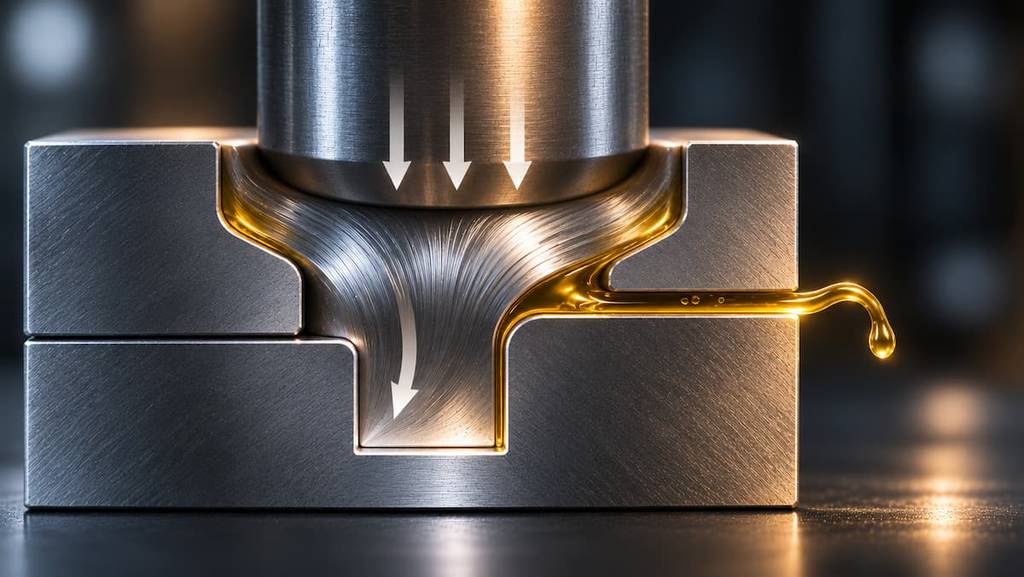
Why, in cold heading, the problem is sometimes not the metal but what stays trapped inside the die.
In cold heading of wire, the cycle is fast and violent: the punch strikes, the wire blank is deformed inside the tooling and, in a fraction of a second, takes the shape of a screw head. Then it happens again, hundreds of times a minute, for entire shifts.
When a detail of the part doesn’t form, suspicion almost always falls on the metal. Too hard, not formable enough, at the limit of what the press can deliver. The wire gets changed, the forming sequence gets adjusted, the die geometry gets reworked.
Sometimes it works. Sometimes it doesn’t. Because the problem doesn’t always lie in what goes into the die. Sometimes it lies in what can’t get out of it.
Clear drawing, clear dimension, wrong part
A customer for whom we make tooling for special fasteners needed a sharp internal corner under the head of a small screw.
The drawing was clear. So was the dimension. The part wasn’t. The part came out with a rounded corner: the metal reached almost to the bottom of the cavity and stopped there. Always in the same spot.
The cause wasn’t the material, and it wasn’t the press. It was the forming oil. With every stroke, a small amount of lubricant stayed trapped in the cavity. As the metal deformed, it pushed the oil towards the bottom, but the oil had no way out.
A liquid is far less compressible than air. When it is confined in a closed space, it can resist strongly enough to stop the metal from filling the cavity completely. In practice, the oil was occupying exactly the space the metal should have reached.
Why this defect is so easy to mistake for another
Incomplete filling can look very much like the result of a material that isn’t formable enough. In both cases the metal stops earlier than expected and the corner comes out rounded instead of sharp.
The difference is in the details. And the details have to be looked for.
When the limit comes from the material or the forming sequence, the defect may change when you change the wire, the tool geometry or the forming conditions.
When the problem is a fluid trapped in the cavity, the defect may stay stubbornly in the same spot, even after changes that should have solved it.
There is another clue: lubrication. The amount and viscosity of the oil, as well as the press speed, can affect what happens. If the lubricant can’t drain away, its presence can become decisive for the result.
These aren’t absolute rules. They are signs worth watching before you intervene. That is why, faced with a corner that won’t fill, the first thing to do isn’t necessarily to change something.
It’s to understand what is happening.
At which station does the defect appear? Is it there from the first parts, or only after a certain amount of running? Does it change when the lubrication changes?
The people running the machine often know these things already, but the information doesn’t always reach the people making the tool.
The obvious solution, and why it couldn’t be used
In cases like this, one of the first solutions to consider is a vent hole: a small passage that lets air and lubricant escape from the cavity.
But there isn’t always room for one. The original die was a disc just 3 mm thick with a tungsten carbide insert. The dimensions were so small that drilling a vent hole risked weakening the insert or interfering with the surface that shaped the screw.
Tungsten carbide is extremely resistant to wear and compression, but more sensitive to tensile stress and stress concentrations.
A hole, especially close to a heavily loaded area, can become a critical point for the integrity of the tool.Solving the filling problem by introducing the risk of breakage wouldn’t have been much of a deal.
Another way was needed.
A real case: two discs instead of one
The solution came from changing the way the die was built. Instead of a single 3 mm disc, we made two stacked 1.5 mm discs. On the mating surfaces we machined small vent channels, a few hundredths of a millimetre deep, connecting the inner cavity to the outside.
Enough to let the oil and air escape, but sized so that the metal could not flow into them during forming.
The oil found its way out. The metal found the corner. The solution worked. And not just in the first trials: many years later, the customer still uses this configuration.
Every now and then, they even remind us of it. We didn’t change the material, or the press. We gave the oil a way out.
What you don’t see: building a die in two pieces
Put like that, it sounds simple. Two discs instead of one, a few channels, done. In reality, splitting a die means shifting part of the difficulty into how it is built.
Two stacked elements have to behave like a single tool: same centring, continuous internal geometry, no step where they meet. On a component this small, even a misalignment of a few microns can leave marks on the formed part.
And then there are the vent channels. Their depth has to be carefully controlled. Too deep, and the metal can flow into them and form a burr. Too shallow, and they may not let enough lubricant drain away.
This is where machining precision becomes decisive. Grinding the mating surfaces, dimensional inspection and machining the channels correctly matter as much as the idea of splitting the die.
Because a good technical solution only works if you can build it correctly.
What this has to do with the way we work
At first glance it looks like a story about ingenuity. In fact, splitting a tool into several elements is nothing new for people in this trade. The interesting point is something else.
The problem wasn’t solved by trying to build the same die better, but by questioning why the part wasn’t coming out right.
The drawing described a geometry. It said nothing about the forming oil, the press speed, or what happened inside the cavity with every stroke.
That information wasn’t on paper. It was on the shop floor. And getting it meant talking to the people who ran that machine. But there is another side to this story that matters to us at least as much as the technical solution.
The customer hadn’t come to us to solve that problem. We were already supplying other tooling. They brought us in because they knew how we work, and knew we would take their difficulty seriously.
There was no request for quotation to answer, and no new product to pitch. There was a problem to understand.
And the chance to tackle it together.
Not every difficulty has a simple solution. Some need trials, changes and attempts. Others may turn out to be incompatible with the constraints of the process.
But the difference is often made by a willingness to look beyond what has been explicitly asked for.
The most interesting technical problems don’t arrive with a request for quotation. They arrive when there is trust.
Before you change the wire or raise the pressure
When a corner, a radius or a detail of the part doesn’t fill as it should, three questions are worth asking.
What stays in the cavity during forming? Oil, air or lubricant residue can prevent complete filling.
Is there a way out? If the fluid can’t drain away, increasing the forming load may not solve the problem, and may put unnecessary stress on the tool.
Does the die really have to be a single piece? Sometimes the solution isn’t changing the material, but rethinking how the tooling is built. These questions don’t automatically give you an answer.
But they help you look for it in the right place.
And if the part still won’t come out right, don’t just send us the drawing.
Send us a defective part as well, tell us at which station the problem appears and at what speed the press runs.
And tell us where the metal stops.
QP Mechanics builds dies, punches and preforming tools in tungsten carbide and tool steels, to customer drawings, for cold heading of wire and special fasteners.