


Why, on spring collets and on any part that works under fatigue, material, machining and heat treatment can’t be chosen separately.
A tool that wears out is a dull problem. It gives you warning, it can be measured, and it can be replaced at the right time.
A part that breaks is a different story. It works fine right up to the cycle before, and then everything stops.
And when it always breaks in the same spot after a few hours, it stops being bad luck. It becomes a message.
The problem is reading it.
A part that is harder than it looks
Spring collets look like simple components: a body, a few fingers and a gripping area. In reality they do one of the most thankless jobs on the whole machine.
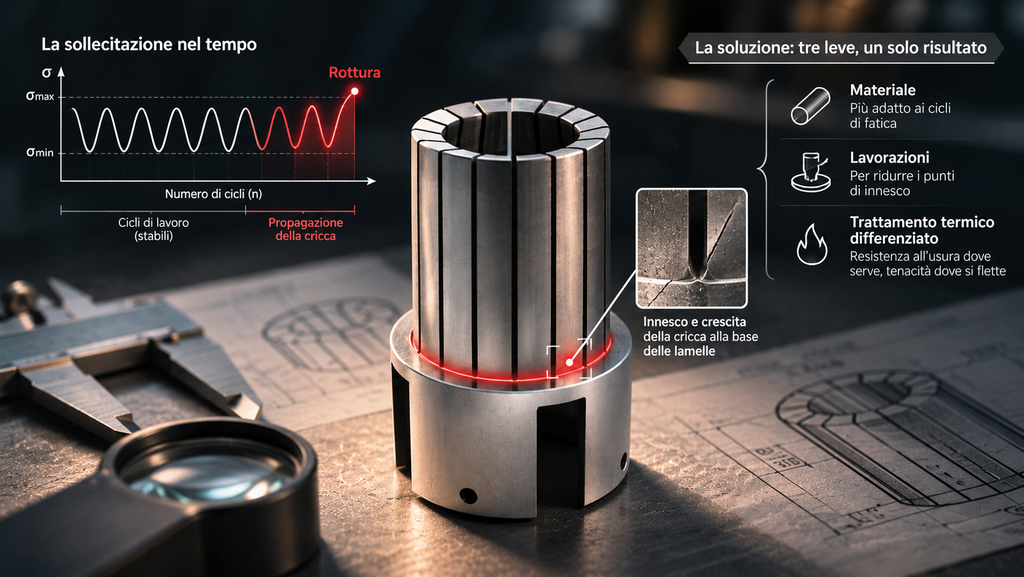
They open and close hundreds of thousands of times. With every cycle the fingers flex, and the stress repeats in exactly the same way, always in the same places.
The gripping area needs wear resistance. The fingers need resistance to breakage. These two demands pull in opposite directions.
And unlike wear, fatigue gives no warning.
Wear and fatigue: two different ways to fail
It’s worth stopping for a moment on this difference, because it explains almost everything else.
Wear is a surface process. Material is lost a little at a time, dimensions drift and the finish gets worse. It is slow, visible and, within limits, predictable. Anyone who knows where to look can spot it before it becomes a problem.
Fatigue works differently. A load that would never break the part on its own, repeated hundreds of thousands of times, starts a microscopic crack. The crack grows a little with every cycle, with nothing visible from the outside. Then, when the remaining section can no longer hold, the part fails all at once.
That is why a component under fatigue can look perfect until the very last moment. And that is why solutions designed for wear, such as a harder material, are not necessarily the right ones.
There is one more detail that makes fatigue especially treacherous: the crack almost always starts at the surface, at the most highly stressed point. What happens in those few tenths of a millimetre often matters more than the properties of the material as a whole: how the part was machined, how it was treated, what finish it has.
A real case: the collet that lasted a few hours
A customer we have supplied for years with dies with tungsten carbide inserts showed us a damaged spring collet. The problem had been going on for some time: despite several attempts, the part kept breaking in the same spot after a few hours of operation.
He didn’t ask us for a quote. He asked us what we thought.
We asked for the drawing and, above all, for the broken part. Then we tried to understand how it worked: how many cycles, under what loads, and where on the machine.
The result was a sample batch with three changes. Not one: three.
It isn’t always the part’s fault
Before touching material, machining or heat treatment, there is one question to ask: is the part working under the conditions it was designed for?
A misalignment during assembly, an impact that repeats with every cycle, a higher-than-expected load at a particular point in the stroke: all of these shorten the life of a component under fatigue, and none of them can be fixed by changing the steel.
That is why, before proposing any change, we asked how the collet worked. Not to shift the blame onto the machine, but because a better-designed part, fitted under the same wrong conditions, is likely to end up the same way. Just a little later.
In the case of the collet, the working conditions were as intended. The problem was in the part. But it’s a check always worth making, and it costs far less than a sample batch.
First lever: the material
A steel with good wear resistance is not automatically a steel with good fatigue resistance. They are different properties, and on a part that has to flex hundreds of thousands of times, the second matters more than the first.
So we chose a steel better suited to withstanding that kind of cycling.
It’s the same reasoning that applies to tungsten carbide, which we wrote about when discussing chipped and worn tools: the hardest material is not necessarily the best.
Second lever: machining
A fatigue crack doesn’t start at random. It almost always starts where stress concentrates and the surface gives it a foothold: a radius that is too tight, a machining mark in the wrong place, a surface altered by a previous operation.
We changed some of the machining operations specifically to reduce the risk of crack initiation in the most highly stressed areas.
The drawing was the same. What had changed was the way we got there.
This point is often underestimated. Two parts that are identical on the drawing, with the same dimensions and the same tolerances, can have very different lives if they were machined differently. The drawing controls the shape. It doesn’t control the history of the surface.
Third lever: heat treatment
This is the least intuitive part.
A uniform hardness forces a choice: either the part resists wear where it grips, or it resists breakage where it flexes. But why settle for a compromise when the two areas need different things?
We took another route: a heat treatment with differential hardness. Higher where wear resistance was needed, lower where toughness was needed.
One part, two different behaviours.
Why changing just one isn’t enough
When something breaks, the temptation is to change one variable at a time. In many cases, that’s a reasonable approach too. On a part under fatigue, though, the three levers are linked.
A tougher steel with the same machining can keep cracking from the same surface mark. Better machining on a part that is too hard in the fingers moves the problem along by a few thousand cycles, but doesn’t eliminate it. A well-designed heat treatment on the wrong material can’t work miracles.
Each of these changes, on its own, can look like a step forward. Together, they can change the nature of the problem.
There’s also a practical advantage to this approach. When material, machining and heat treatment are thought through together, the sample batch is no longer a shot in the dark.
It’s a solution to be put to the test.
And if it doesn’t work, at least you know where to look.
How it turned out
The first test was a success right away.
The collet that used to break after a few hours had passed the test.
The customer entrusted us with the entire production of those components, and since then has also involved us in other technical issues. He hadn’t chosen us to solve that problem: we were already his supplier for other parts.
But that collet changed something.
We’re not telling this story as a recipe. Another collet, on another machine, could break for different reasons and call for different choices.
We’re telling it because it shows something that holds true almost every time: material, machining and heat treatment are not three separate decisions. Changing just one of them often moves the problem instead of solving it.
What to bring when a part breaks
Understanding why a component fails doesn’t always take a lab. It takes a few pieces of information that, all too often, end up in the scrap bin along with the part.
- The broken part. Don’t throw it away. In a fatigue failure, the fracture surface often has a smoother area, where the crack grew slowly, and a rougher one, where the part gave way all at once. It shows where the crack started better than any description could.
- How long it lasts before breaking. Hours, cycles or parts produced. Even an estimate is better than “after a while”.
- Where it breaks. Always in the same spot or in different places: these are two different problems.
- How it works. Cycle rate, loads, and any known impacts or misalignments.
A failure that keeps happening in the same spot isn’t bad luck.
It’s a clue. Bring it to us.
QP Mechanics manufactures dies, punches and precision components in steel and tungsten carbide, to the customer’s drawing or from a sample.