


Why, in aluminium impact extrusion, tooling should be judged by pieces produced, not by purchase price
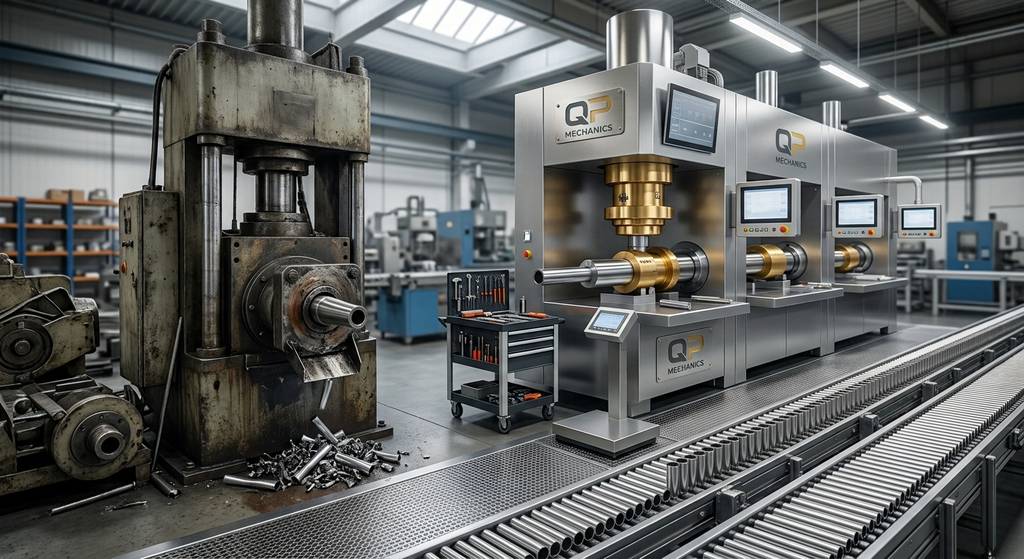
On an impact extrusion line the cycle is brutal and very simple: the punch comes down, the aluminium slug is forced up along the wall of the die, and in a fraction of a second a flat disc becomes a tube, shaped by punches and carbide dies. Then it happens again, 100 to 200 times a minute, shift after shift.
Every stroke is an extremely high compressive load combined with metal sliding across the surface of the tool. The die is not simply “used”: it is systematically attacked. So the economic question that matters is not how much it costs, but how many tubes it produces before it goes out of tolerance.
And it makes no difference what that tube will contain. Ointment, toothpaste, anchovy paste: for the die it is the same container, and the calculation works the same way.
The calculation almost nobody makes
Take two dies for the same tube, both in tungsten carbide. Same material on paper, same drawing. There is only one difference: the first is made on the cheap, the second is made to the highest standard.
| Die made on the cheap | Die made to the highest standard | |
|---|---|---|
| Tool price | 1,000 | 1,400 |
| Tubes produced before replacement | 400,000 | 1,100,000 |
| Tooling cost per million tubes | 2,500 | 1,273 |
| Replacements per 10 million tubes | 25 | 9 |
Average values based on feedback collected by QP Mechanics from its customers over the years, for carbide dies on aluminium tube extrusion lines running at 100–200 strokes per minute.
The well-made die costs 40% more and, for every tube produced, costs about half as much. And that is before counting the most expensive part of the story.
It is worth stressing: we are not comparing carbide with steel here. Against a steel die the gap would be even wider. We are comparing two dies in the same material, and the only difference is who makes them.
The cost that really matters: the tool change
Replacing a die on an impact extrusion line is never a neutral operation. It means stopping, dismounting, mounting, realigning, restarting, checking the first parts and possibly scrapping them. Even when it is handled well, it is time during which the line produces nothing.
At 150 strokes per minute, every hour of downtime means about 9,000 tubes not made. In the table, the cheaply made die forces 16 extra changes every 10 million pieces: that is not 16 more tools, it is 16 more stoppages. On a line running at this rate, the value of the lost production easily exceeds the price of the die itself several times over.
That is why, in this process, the purchase cost of tooling is one of the least significant items in the total cost. And at the same time it is the only one that appears during negotiation.
Where the difference between one die and another is hidden
If the material is the same, what separates 400,000 tubes from more than a million? Not one single thing, but a series of details that cannot be seen on a drawing and that are all paid for over the life of the tool.
Grade selection. “Carbide” is not one material, it is a family. Grain size and binder content shift the balance between wear resistance and impact resistance, and the right grade for a die extruding aluminium at 200 strokes per minute is not the cheapest one in stock.
Steel shrink ring. Carbide performs well under compression and poorly under tension. A correctly dimensioned shrink ring pre-stresses the insert and protects its life; an approximate one leaves it exposed exactly where the load is highest.
Finish of the sliding surfaces. Where aluminium flows under pressure, surface quality is not cosmetic: it governs friction, metal adhesion and therefore how quickly the die degrades.
Radii, edges and geometry. A poorly executed radius or approximate concentricity concentrates stress in one point. That is where the tool starts to give way, long before it should.
None of these aspects is visible in a quotation. All of them show up on the stroke counter.
How to build the comparison in your own plant
Our values are an average: they show the order of magnitude. The figure that really counts is yours, and it depends on your alloy, your lubrication and your line speed. To get it you need three things, all already available on the shop floor:
Count pieces, not months. Record how many tubes each die produced between mounting and replacement. It is the only denominator that makes different suppliers comparable.
Note the reason for replacement. Out of tolerance, chipping, surface scoring: these are different causes and they lead to different choices.
Put a cost on downtime. Even a rough estimate of the line’s hourly value radically changes the ranking of the offers.
With these three numbers, evaluating tooling stops being a question of price and becomes a question of arithmetic.
QP Mechanics manufactures dies, punches, bushes and rings in tungsten carbide and tool steels, to customer drawings, for aluminium impact extrusion and metal packaging.